
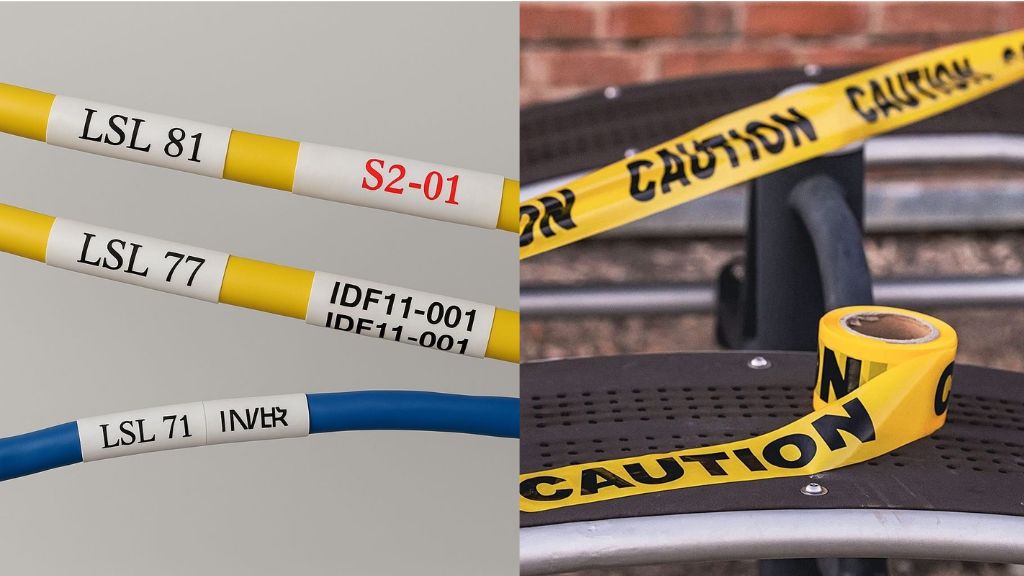
A cable route marker and underground cable warning tape serve different jobs: the marker gives a visible above-ground reference point, while the tape gives excavators a last-warning layer just above the cable itself. Most UAE underground cable projects use both together rather than choosing one over the other. This guide compares cable route marker vs warning tape use cases, explains what each protects against, and covers what electrical contractors, HSE officers, and procurement teams should check before specifying underground cable identification for a project.
Key Takeaways
- A cable route marker sits above ground as a visible reference point; cable warning tape sits buried just above the cable as a last-line warning.
- Most UAE sites specify both cable route markers and warning tape together, since each protects against a different risk during excavation.
- Cable route markers suit long-term, visible reference along a route; warning tape suits protecting the cable itself during any future digging.
- Exact spacing, colour, and marker requirements vary by utility authority — such as DEWA — and by project, so confirm the specification before ordering.
- Choosing between the two, or using both, depends on cable voltage, route length, site access, and how often the area sees future excavation.
What Is a Cable Route Marker?
A cable route marker is an above-ground utility marker post or plate that shows where an underground cable runs. Cable route markers typically carry a route reference, direction, and sometimes cable ID and circuit number, so anyone on site can trace the route without digging. They’re a visible, long-term reference point rather than a physical barrier — the marker tells you a cable is nearby, not exactly how deep it sits.
What Is Underground Cable Warning Tape?
Cable warning tape is a buried strip, typically brightly coloured and printed with a repeated warning message, laid in the trench above the cable during installation. Unlike a cable route marker, warning tape isn’t visible from the surface — it’s only found once someone starts digging, at which point it signals to stop before reaching the cable itself. Warning tape works as underground utility marking that activates during excavation, not as a standing reference.
Cable Route Marker vs Warning Tape: Key Differences
The table below summarises how a cable route marker and warning tape differ in function, visibility, and role in cable protection systems.
| Factor | Cable Route Marker | Cable Warning Tape |
| Visibility | Visible above ground at all times | Hidden until excavation reaches it |
| Purpose | Route reference for planning and maintenance | Last-warning barrier during digging |
| Typical placement | At intervals along the route, at bends | Buried in the trench above the cable |
| Information carried | Route reference, direction, sometimes circuit number | Repeated warning text, sometimes voltage or utility name |
| Replaces the other? | No — used alongside tape on most projects | No — used alongside markers on most projects |
When Should You Use Cable Route Markers Instead of Tape?
Cable route markers matter most where a route needs a long-term, visible reference — along an open corridor, at property boundaries, or wherever future maintenance teams need to locate the cable without records. A cable route marker plate at each change of direction helps crews trace the route accurately, particularly on longer runs where relying on drawings alone increases error risk.
When Is Warning Tape the More Important Layer?
Warning tape becomes the critical layer wherever a route runs under ground that’s likely to be excavated again — road crossings, shared utility corridors, or areas near other buried services. Since tape sits directly above the cable, it gives a final, close-range warning that a marker post at a distance can’t provide. On HV or LV cable marking projects, tape is often specified for this reason even where visible markers already exist.
Can Cable Route Markers and Warning Tape Be Used Together?
Yes, and most UAE underground cable projects specify both. Markers give an ongoing above-ground reference for planning and site access, while tape protects the cable directly during any future digging near the route. Using only one leaves a gap: markers alone don’t stop a trench from reaching the cable, and tape alone gives no visible reference until someone is already excavating.
Expert Insight
The mistake we see most often isn’t choosing the wrong option — it’s leaving gaps in coverage between markers. A cable route marker every few hundred metres looks fine on paper, but if the interval doesn’t match the site’s actual excavation risk points (crossings, access roads, planned future works), the route effectively goes unmarked in the areas that matter most. We size marker spacing against the site plan, not a generic default.
Conclusion
Cable route markers and warning tape solve different problems — one gives a visible reference above ground, the other protects the cable itself during digging — and most UAE projects use both together. Since exact spacing and specification requirements vary by authority and project, confirm the details before finalising your marking plan. For cable route markers made to your project’s exact specification, visit cdllc.ae or message us on WhatsApp at https://wa.me/971501463864.
FAQ
What is the difference between a cable route marker and warning tape?
A cable route marker is a visible above-ground post or plate showing where a cable runs; warning tape is buried just above the cable itself and only becomes visible during excavation.
When should you use cable route markers instead of warning tape?
Use cable route markers where a visible, standing reference matters for planning and maintenance — they don’t replace the protective role warning tape plays directly above the buried cable.
Which is better for underground cable identification in the UAE?
Neither replaces the other — most UAE projects combine cable route markers with warning tape, since one gives visible reference and the other gives close-range protection during digging.
Can cable route markers and warning tape be used together?
Yes, this is standard practice on most underground cable projects, since markers and tape address different risks and work best as a combined cable protection system.
What factors should you consider when choosing between cable route markers and warning tape?
Consider cable voltage, route length, how often the area is likely to be excavated again, and the utility authority’s specific requirement — these factors, not preference alone, should guide the decision.
Do UAE utility authorities require both cable route markers and warning tape?
Requirements vary by authority and project; a DEWA-related route may follow a specific approved specification, so confirm directly with the utility or consultant rather than assuming a fixed UAE-wide rule.
How far apart should cable route markers be placed?
Spacing depends on the project specification and site conditions, particularly at changes of direction or crossings — there’s no single fixed interval that applies to every route.