
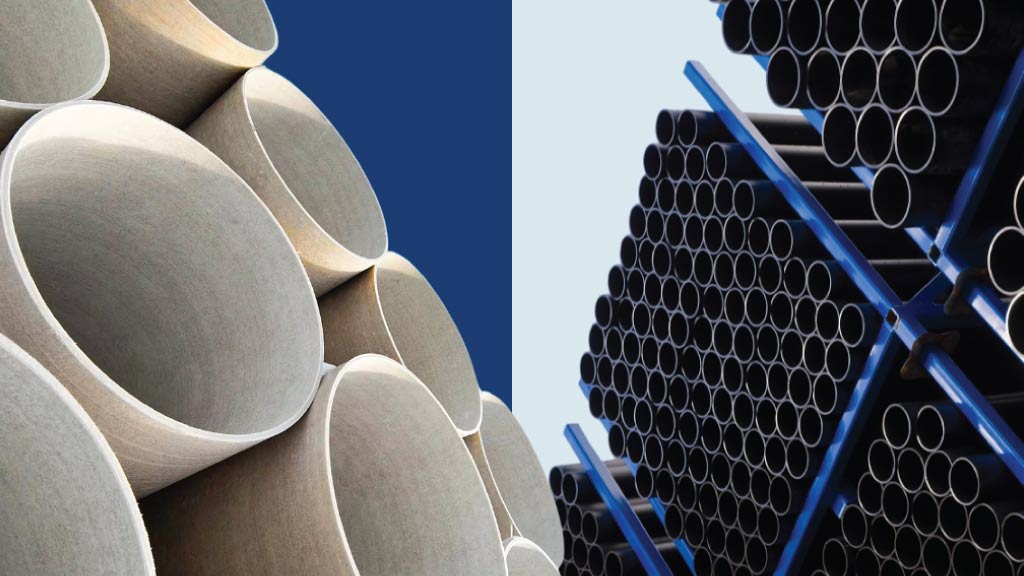
For most UAE and KSA pipeline and utility projects, a GRP marker post outperforms HDPE on UV resistance, structural rigidity, and long-term desert durability, while HDPE remains a lower-cost option for shorter-life or lower-exposure applications. Choosing between a GRP vs HDPE marker post comes down to site conditions, expected service life, and budget. This guide compares both materials against the specific demands of Gulf climates — extreme heat, UV load, sand abrasion, and corrosive soil — so MEP engineers and procurement teams can specify the right marker post the first time.
Key Takeaways
- GRP marker posts resist UV degradation better than HDPE marker posts over a 10+ year service life in Gulf sun exposure.
- HDPE marker posts cost less upfront but are more prone to brittleness and colour fade under prolonged desert climate conditions.
- GRP is non-conductive and corrosion resistant, making it suited to pipeline marker posts and utility marker posts near buried metallic infrastructure.
- Underground utility identification projects with strict ROW (right-of-way) marking requirements typically specify GRP for longevity.
- Material choice should follow site exposure, expected lifespan, and whether the post is for pipeline marker posts, oil & gas infrastructure, or general utility marker posts.
What Are GRP Marker Posts?
GRP marker posts are made from glass reinforced plastic, a composite formed by pultruding glass fibres through UV-stabilised polyester resin. This process gives the post a rigid, corrosion resistant profile that holds its shape and colour under sustained sun exposure. GRP marker posts are widely used for pipeline identification and underground utility identification because they don’t conduct electricity, which matters near live cable routes.
What Are HDPE Marker Posts?
HDPE marker posts are moulded from high-density polyethylene, a thermoplastic valued for flexibility and impact absorption. They cost less to produce than GRP marker posts and install quickly, but HDPE softens under intense heat and can become brittle after years of UV exposure — a real constraint in Gulf desert climate conditions.
UV Resistance: How Each Material Holds Up
UV resistance is the single biggest differentiator between GRP vs HDPE marker posts in this region. GRP’s UV-stabilised resin layer slows fading and surface chalking, keeping printed legends legible for longer. HDPE requires UV-stabilising additives at manufacture, but even stabilised HDPE typically shows more visible degradation within 5-7 years of constant sun exposure than GRP does over a decade.
| Factor | GRP Marker Post | HDPE Marker Post |
| UV resistance | High — UV-stabilised resin | Moderate — depends on additive quality |
| Rigidity | High, holds shape under load | Flexible, can deform under heat |
| Corrosion resistance | Excellent, non-metallic | Excellent, non-metallic |
| Typical service life (UAE/KSA) | 10-15 years | 5-8 years |
| Upfront cost | Higher | Lower |
| Conductivity | Non-conductive | Non-conductive |
Durability Under Desert Climate Conditions
Desert climate conditions combine high UV load, large day-night temperature swings, and wind-driven sand abrasion. GRP’s rigid composite structure resists surface pitting from sand abrasion better than HDPE, which can scuff and dull faster. Extreme heat also affects HDPE more — the material can soften at high surface temperatures, causing slight warping in exposed installations.
Corrosion Resistance and Underground Use
Both GRP and HDPE marker posts resist corrosion, which is why both remain common for pipeline marker posts and utility marker posts over buried metallic assets. Neither material rusts or reacts with typical Gulf soil chemistry, so the deciding factor for underground utility identification projects is usually UV performance above ground and expected post life, not corrosion.
Suitability for Pipeline and Oil & Gas Infrastructure
For oil & gas infrastructure and pipeline marker posts along exposed corridors, GRP is generally the stronger long-term specification because posts are rarely replaced on a short cycle and downtime for re-marking a route is costly. HDPE can still suit shorter pipeline sections, temporary marking, or lower-priority utility marker posts where budget outweighs a 10+ year lifespan requirement.
Cost and Maintenance Comparison
HDPE marker posts typically cost less per unit and less to install in bulk, which appeals to large-scale utility marker posts rollouts on tight budgets. However, factoring in replacement cycles, GRP often works out more cost-effective over a 10-15 year horizon because it needs fewer reprints and replacements. Maintenance for both materials is minimal — periodic legend inspection and occasional cleaning — but GRP retains its finish longer between maintenance visits.
Expert Insight
On the fabrication floor, the difference shows up fastest in colour retention. A batch of HDPE marker posts installed alongside GRP posts on the same site will visibly yellow first, usually within two to three UAE summers, while the GRP posts hold their pigment. For clients unsure which to specify, we recommend GRP by default for any post expected to stay in place past five years, and reserve HDPE for temporary or short-cycle marking only.
Conclusion
GRP and HDPE marker posts both resist corrosion and suit underground utility identification work, but they diverge sharply on UV resistance and lifespan in Gulf desert climate conditions. For long-term pipeline marker posts and utility marker posts, GRP is the stronger specification; HDPE remains a fit for shorter-cycle or budget-driven projects. For a marker post material recommendation matched to your site conditions, visit cdllc.ae or message us on WhatsApp at https://wa.me/971501463864.
FAQ
Is GRP better than HDPE for marker posts in the UAE?
For most permanent installations, yes — GRP marker posts resist UV degradation and sand abrasion better than HDPE over a 10+ year service life in UAE desert climate conditions.
Are HDPE marker posts suitable for Saudi Arabia’s climate?
HDPE marker posts can work in KSA for shorter-term or lower-exposure marking, but expect faster UV-related fading and stiffness loss than GRP over the same period.
Do GRP and HDPE marker posts meet the same standards?
Both can be manufactured to meet UAE pipeline identification and utility marking requirements; specific approvals depend on the project authority, such as Dubai Municipality or the relevant utility provider.
Which material is non-conductive for use near cable routes?
Both GRP and HDPE marker posts are non-conductive, making either suitable near buried cable and pipeline routes from an electrical safety standpoint.
How long do GRP marker posts last outdoors in the Gulf?
GRP marker posts typically last 10-15 years in UAE/KSA outdoor conditions, depending on installation quality and exposure level.
Is HDPE cheaper than GRP for marker posts?
Yes, HDPE marker posts generally cost less upfront than GRP, though GRP can be more cost-effective over a longer replacement cycle.
Can marker posts be customised with bilingual Arabic/English text?
Yes, both GRP and HDPE marker posts can carry a bilingual Arabic/English decal for pipeline identification and utility marker post projects across the UAE.